The Reified World of Uncut Gems: Anxieties of Speculative Capitalism
“In societies dominated by modern conditions of production life is presented as an immense accumulation of spectacles.” — Guy Debord (2024)
The Safdie brothers’ Uncut Gems serves as a perfect cinematic reflection of the dangerous speculation and financial recklessness that plagues modern capitalism. The movie is an anxiety-driven ride and manages to masterfully capture the intensity and pressure of a world driven by high-stakes gambling, speculative capitalism, and the relentless pursuit of wealth. Howard Ratner, played by Adam Sandler, embodies the chaos and desperation inherent in a system driven by speculative gambles, much like the volatile markets and frequent economic crises that plague our current economic system. In both, Howard’s life is an allegory of the high-risk behavior that modern capitalism encourages, always speculating on uncertain futures while our grasp on the present loosens.
The Cinematic World of Speculative Anxiety
The Safdie brothers set the mood of constant motion and anxiousness right from the start of the movie. The tale begins in Ethiopia when miners find a rare black opal, which becomes the film’s central gemstone. After the opal is extracted and placed in Howard’s hands, the action picks up speed. The camera observes this entire process with unrelenting intensity.
High-stakes wagers, heated conversations, and the constant fear of violence from the loan sharks that he owes enormous sums of money to dominate Howard’s life. The audience is lured into Howard’s chaotic world as the stakes mount, where every choice he makes appears to drive him closer to impending catastrophe.
Adam Sandler’s Howard Ratner is a man who embodies the spirit of speculative capitalism. He is constantly over-leveraged, betting other people’s money on high-risk gambles. His obsession with winning, and the adrenaline that accompanies it, drives him to make decisions that not only jeopardize his financial future but also his relationships with those closest to him.
The 2022 UK recession crisis, where pension schemes teetered on the edge of collapse due to risky investment strategies, underscores how deeply embedded speculative gambling has become in all areas of the capitalist economy (Partington, 2022a). Howard seeks quick profits and high returns by pushing the boundaries of risk. Speculation and betting are equivalent to the satisfaction of his sexual desires—we are flashed with scenes where the fruition of his speculation incites a response very similar to the satisfaction of one’s sexual desires.
Just as Howard pawns Garnett’s championship ring to place a massive bet, UK pension schemes invested in risky financial products, triggering a market collapse that nearly wiped out the savings of millions of ordinary people. The intervention by the Bank of England (Partington, 2022b) to prevent disaster is reminiscent of the last-minute reprieves Howard receives in the film, but with the lingering knowledge that these temporary fixes cannot stave off inevitable collapse forever.
The Fetishism of the Black Opal
At the heart of Uncut Gems is the black opal, a rare and valuable gemstone that Howard has smuggled into the United States from Ethiopia. For Howard, the opal represents a way out of his financial troubles—a potential million-dollar windfall that could solve all of his problems. For Kevin Garnett, the opal holds a different kind of value. The basketball star becomes fixated on the gem, believing that its power will enhance his performance on the court.
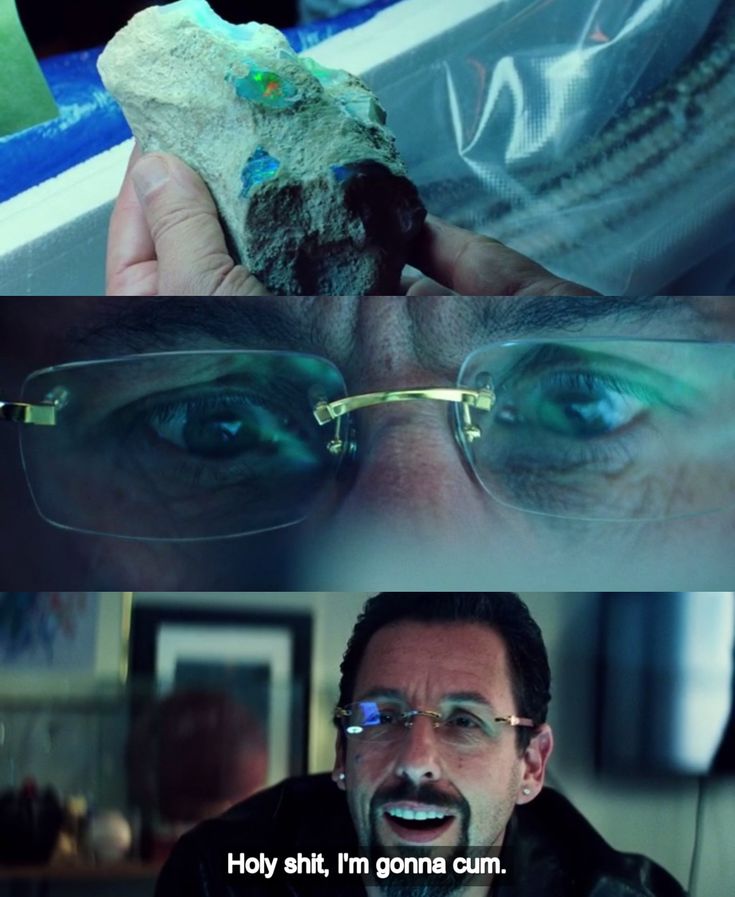
The frenetic pace of Uncut Gems mirrors the anxiety of speculative capitalism
In Marx’s theory of commodity fetishism, commodity exchange under capitalism are mask the labor and exploitation that went into their production (Marx, 1993). The opal, which Howard plans to auction off for a huge profit, becomes a symbol of hope and fortune for him, while the human labor that extracted the gem in Ethiopia is completely erased from the narrative. This mirrors the capitalist practice of commodifying labor and natural resources, transforming them into objects of desire that take on lives of their own.
Howard’s obsession with the opal blinds him to the reality of his situation. Despite mounting debts and the constant threat of violence from loan sharks, he refuses to sell the opal to Garnett directly, convinced that he can get a higher price at auction. This refusal to let go of the gem, even when it could save him, speaks to the larger theme of capitalist greed and the inability to recognize when enough is enough.
Ratner is a lone individual in his story, his personal and social relationships reduced to mere transactions. Georg Lukács’ 1923 article on reification had a significant impact on critical theory. Lukács paired Weber’s analysis of bureaucracy, which extends this instrumentalizing approach to all social spheres, with Marx’s critique of the “fetishism of commodities,” which makes social connections between people appear as measurable and thing-like.
When one views things only from the standpoint of their marketability, reification becomes “the necessary, immediate reality of every person living in capitalist society” (Lukács, 1972). This can be used to describe an instrumentalizing attitude toward other people, objects (whose qualitative features are reduced to quantitative terms), and aspects of one’s own personality. Our protagonist’s world resembles this to a great extent, caught up in the web of unethical decisions and an even more unethical economic system.
Extractive Capitalism and the Indian Context
At its core, Uncut Gems is a critique of the unsustainable nature of capitalism, particularly its speculative, high-risk aspects. The export of primary commodities, such as agricultural and mineral materials, rather than manufactured goods is known as “extractive capitalism” (James Petras, 2013). Neoliberal capitalism coupled with predatory extractive industries and government assistance always results in an excess of dispossessed and depeasantized laborers who migrate seasonally in an attempt to diversify their sources of income between mining and agriculture (Roy Chowdhury & Lahiri-Dutt, 2016).
In the Indian context, gambling regulations reveal interesting contradictions. The majority of gambling operations are regulated or controlled, with a few exceptions such as lotteries and horse racing. Since gambling is a state matter in India, only the state governments have the authority to legalize and regulate it for their own regions. The general law governing gaming in India is the Public Gaming Act 1867. India’s regulatory framework distinguishes between two types of games: those requiring skill and those requiring chance—a distinction that mirrors capitalism’s own blurred lines between “calculated risk” and pure speculation.
The suspense in the movie reaches unbearably high levels as it speeds toward its climax. Howard makes a huge three-way parlay wager on Garnett’s performance in a crucial NBA game in an attempt to pay off his loan shark, Arno. There’s a lot of suspense in this scene as Howard watches the game and hopes that a win will finally liberate him.
Uncut Gems, however, is not a movie that provides simple answers. At the very end, as Howard celebrates his $1.2 million payday and Garnett’s team wins, the movie pulls off a vicious, unexpected turn. Phil, one of Arno’s hired goons, shoots Howard in the face, killing him instantly. The suddenness of this act is a stark reminder that in the world of Uncut Gems, no amount of money or success can protect you from the consequences of your actions. The capitalist dream that Howard has been chasing throughout the film is revealed to be a lie, as his life is cut short just as he believes he has won.
Conclusion: A Cinematic Critique of Capitalist Irrationality
Uncut Gems and the current state of the economy serve as examples of how speculation and gambling—which are essential components of capitalist systems—cause chaos, instability, and fragility. Unrestrained profit-seeking breeds financial systems based on “fictitious capital”—value existing only in the mind—much as the derivatives and other intricate instruments that precipitated the global financial crisis of 2008.
Howard’s desperate acts are similar to those of capitalist organizations that make risky investments without thinking through the repercussions, ultimately risking millions of people’s livelihoods. Despite his slight success, Howard’s eventual downfall illustrates how unsustainable a capitalist system that puts short-term gains ahead of long-term stability is.
The obsession with maximizing returns—whether in the diamond district of Manhattan or in British pension funds—perpetuates a cycle of risk-taking and collapse, where the benefits are enjoyed by the few, and the costs are borne by the many. Ultimately, just as the current financial crises call for a fundamental restructuring of economic systems, Uncut Gems offers a window into capitalism’s inherent instability through the unstable camerawork showcasing the cascading effects of Ratner’s choices.
The film portrays a world where there are no “safe bets”—where the pursuit of profit leads to fragility and chaos. In both cinema and real life, the lesson is clear: the speculative, casino-like nature of capitalism is unsustainable, and only by fundamentally transforming these systems can we hope to escape the perpetual cycles of crisis and collapse.
Bibliography
Althusser, L. (2006). Lenin and philosophy and other essays.
Debord, G. (2024). The society of the spectacle. PM Press.
James Petras. (2013). Brazil: Extractive Capitalism and the Great Leap Backward. World Review of Political Economy, 4(4). https://doi.org/10.13169/worlrevipoliecon.4.4.0469
Lukács, G. (1972). Reification and the Consciousness of the Proletariat. In History and class consciousness: Studies in Marxist dialectics.
Marx, K. (1993). Capital: A Critique of Political Economy (Vol. 1).
Partington, R. (2022a, September 22). UK in recession, says Bank of England as it raises interest rates to 2.25%. https://www.theguardian.com/business/2022/sep/22/bank-of-england-interest-rate-rise-latest
Partington, R. (2022b, October 6). Bank confirms pension funds almost collapsed amid market meltdown. https://www.theguardian.com/business/2022/oct/06/bank-of-england-confirms-pension-funds-almost-collapsed-amid-market-meltdown
Roy Chowdhury, A., & Lahiri-Dutt, K. (2016). The geophagous peasants of Kalahandi: De-peasantisation and artisanal mining of coloured gemstones in India. The Extractive Industries and Society, 3(3), 703–715. https://doi.org/10.1016/j.exis.2016.03.007